A while ago I hinted at an ant that doesn’t walk in a poor attempt at humour. Now I will explain and I promise you, the payoff probably isn’t worth it.
When we think of ants we think of huge colonies of ants running about, doing their thing. Not all ants do this. You see, this is a lot of effort. Nature and evolution follow a path of least resistance so survival strategies are always balanced between the energy required and the gain from said strategy. Ants work together to survive. It works. Some species are a bit more lazy about it.
As I have discussed in the past, many ants are socially parasitic. Some take this to a whole new level. The species we will be specifically covering is Tetramorium atratulum (Formerly Anergates atratulus). And I can tell you now, they are weird. These are one of the ants that I have alluded to from our very first post. These ants are worker-less. They only have males and Queens. Pretty weird. They purely rely on the workers of their host species which are also from the genus Tetramorium. As they exist in queenless host colonies and don’t produce their own workers, their colonies are doomed to die when the existing workers die out. This gives her no more than 2 or 3 years to secure the next generation.

The queen is smaller than her host workers. She doesn’t need to be any bigger. Also, the larger the ant is, the longer they take to grow and mature. In a situation where you have extremely limited time to reproduce, speed is everything. As she has so little time she needs to pump out eggs as fast as possible. Her abdomen becomes physogastric, becoming extremely swollen with eggs.
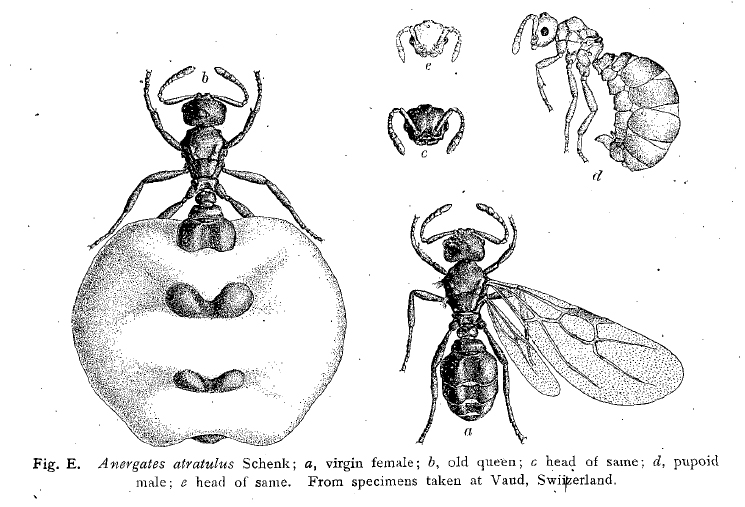
As weird as the females are, the males are just bizarre. They are often described as pupoid as they resemble pupae. They have no wings, underdeveloped legs and they have a very thin exoskeleton. When most ants become adults, their exoskeleton hardens so they can walk and are harder to injure. Not these guys. That is a waste of time if you never do anything. So they just sit there, pretty much unable to move. They don’t leave the nest in mating flights so mating occurs in the nests. They’re essentially just bags of sperm instead of flying bags of sperm like most male ants are. They mostly exhibit inbreeding but do mate with unrelated individuals in the rare cases where a single nest contains multiple, unrelated parasite queens.

As they are so reliant on their host species and rely on extremely specific circumstances, they are classed as Vulnerable by the IUCN throughout their European range. I will be covering ant conservation in the future but for now we will skip over that. It is a much bigger issue than most people realise so deserves a post of its own.
So there you have it. An ant species that defies almost all characteristics associated with ants. No mating flights and no workers. But it works, unlike the males’ legs. But at least they have Queens. Yeah there are species that don’t. Stay tuned for that one! Please share this post around as I am hoping to grow the community and share more! For now I will say thank you very much for reading and I hope you enjoyed,
Alex.
Glossary
Physogastric- Where the abdomen of a Queen greatly increases in size.
Pupoid- Resembling a pupa.
References
Dash, ST and Sanchez, L., 2009. New distribution record for the social parasitic ant Anergates atratulus (Schenck, 1852) (Hymenoptera: Formicidae): an IUCN red-listed species. Western North American Naturalist , 69 (1), pp. 140-141.
Heinze, J., Lautenschläger, B. and Buschinger, A., 2007. Female-biased sex ratios and unusually potent males in the social parasite Anergates atratulus (Hymenoptera: Formicidae). Myrmecological News, 10, pp.1-5.
Schulz, A., 2002. Notes on the socially parasitic ants of Turkey and the synonymy of Epimyrma (Hymenoptera: Formcidae).
Social Insects Specialist Group (1996). “Anergates atratulus“. The IUCN Red List of Threatened Species. IUCN. 1996: e.T1285A3390729. doi:10.2305/IUCN.UK.1996.RLTS.T1285A3390729.en
Wheeler, W.M., 1908. Comparative Ethnology of the European and North American Ants.
Wheeler, W.M., 1909. Observations on some european ants. Journal of the new York entomological society, 17(4), pp.172-187.
If you have enjoyed this site and its content please consider donating so I can add more content in the future.
 Alex's Ants