Whether you are studying ants, have found an ant in your kitchen or are just curious about ants it often helps to know what ant you are looking at. With Thousands of ant species around the world it is hard to figure out which one is which. This is especially true with fossils and even pinned insects. You might not even know where they were collected. Worst of all is that a load of identification requires specific training or equipment. Not everybody has a decent microscope just lying around. I certainly don’t! So this guide has been made so it is usable by anyone and can be used with any ant you may find. However, and it is a big however, this was not always possible. Taxonomy as a whole is pretty arbitrary so the differences between different subfamilies is also a pain.
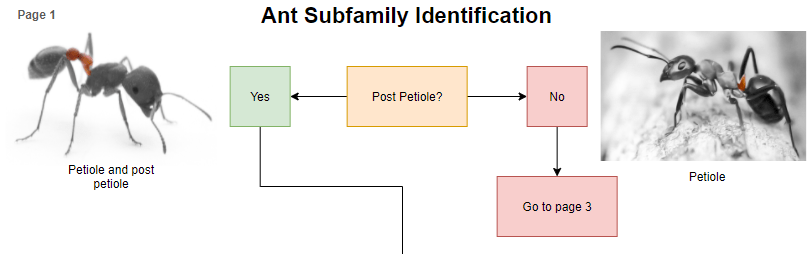
I have previously said that my biggest weakness in studying ants is identifying ants based on official reports. Most of my identification skills rely on me saying “It looks like…” Although this has worked for me up until now I want the actual skills necessary to do so so I have decided to teach myself how to do so. As of writing this, I have already done this work and it is very overwhelming. I thought I may as well teach you how to do so too and make my own ant identification guide. The biggest issues with these guides are that they use extremely complex jargon, the often require microscopes and other expensive equipment to do so and they are always done by region or country. Because I hate myself that much I have decided to do ALL ants in one go and, to make it even harder, try to make it possible to do so without any expensive equipment that the average person doesn’t have.
Once this is complete I will add ways of narrowing down by region but for now It will be one big guide because I want to learn (And teach) as much as I possibly can about ant identification. So far the guide only covers Sub-families which, honestly, was hard enough. There were under 2 dozen subfamilies and it took forever. There are over 500 genera and over 14,000 species as of writing. Not to mention the fact that the differences between ants becomes smaller and harder to identify the more specific you go. For now, subfamilies will have to do.
The guide highlights the features you will be looking for to help you along the way. I will be adding a page of definitions specific to the guide to make it easier to use. As I said it is still in development so may undergo changes as issues are discovered. There are more, very important, points at the top of the identification guide page that I suggest you read before using the guide.
I would like to take a moment to say that I have made this guide for me but I really hope it is helpful and useful to anyone who needs it. I strongly believe knowledge should be free. I mean that is pretty much the reason this site exists. However, these projects take a lot of time and cause too many headaches. If you like what I have done here and on the site maybe consider becoming a Patron on Patreon. It would really mean a lot. I hate asking for money without offering much in return which leads me onto my next point.
All Images and information used are free to use commercially. If you like the chart would you consider buying a physical copy? Use the poll below to let me know.
This is just testing the waters so the appearance of larger posters, costs etc are all to be decided. Thank you for filling out the poll. All thoughts and opinions are valued. Just be nice! Our Facebook can be found here.
The guide can be found here or via the menu on the homepage.
A long post today! Thank you for sticking with it. I really hope you like it and find it useful! Please share around as much as possible and as always thanks for reading,
Alex.
If you have enjoyed this site and its content please consider becoming a Patron so I can add more content in the future.
 Alex's Ants
Assuming this will be a book: A pdf copy would be great. Just like a new paperback copy, each expansion could offer the same digital update. Charge the same exact paper profit margin as the digital cost, you make the same amount. Use a service that tags the pdf with a user identified or even add it to the Amazon digital store for the option to use Kindle app access. The digital option also allows for delivering minor/smaller updates for digital buyers. If you do it correctly you could make more money from digital compared to paper copies that people will be hesitant to constantly pay for new paper versions.
LikeLike
That is a great Idea! I was thinking of maybe doing a small booklet when I add more charts like to genus level etc
LikeLike