Anatomy is extremely important when identifying species. Anatomy also uses a bunch of complicated words to make it as hard to understand as possible. Not really but it can seem like that when you are first getting into it.
This is a part of my process of teaching myself how to identify ant species using anatomy so I am afraid you’ll have to learn too. This will be a simple reference for identifying specific features used to do so. This is just a list of definitions and a few diagrams but this post is mainly to support this page here.

Definitions
Abdomen: The third body section after the thorax and contains the gaster and petiole
Acidopore: An opening in the rear of the gaster that is used to spray acid or other related chemicals
Alitrunk: The part of the body where the wings attach. The thorax.
Antenna sockets: The point at which the antenna connect to the head
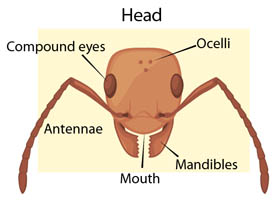
Antennae: The 2 sensory organs on the head which are elbowed (Can lack elbows on male ants)
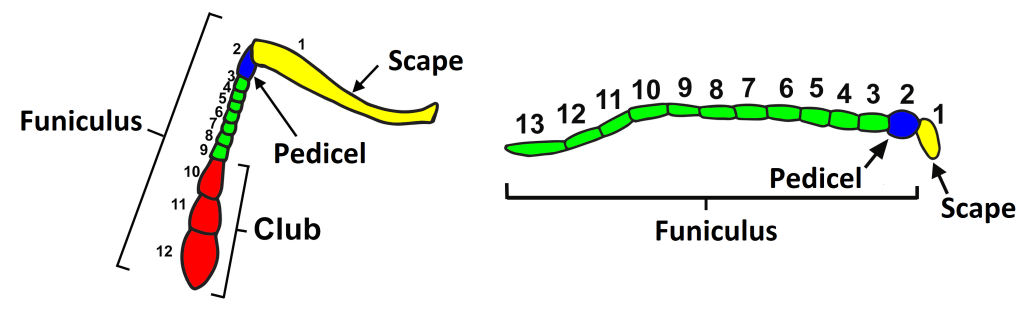
Antennal club: The last few antennal segments are enlarged forming a club (Not always present)
Cuticle: The exoskeleton
Eyes: Compound eyes that can be present or absent and are found at various parts of the head based on species
Exoskeleton: The hard ‘shell’ that makes up the ant’s skeleton
Funiculus: Segmented part of the antenna attached to the scape that include the club if present
Gaster: The most bulbous section of the abdomen that begins at the third abdominal segment after the petiole
Head: The forward most section of the body
Mandibles: The most obvious mouthparts used for biting and manipulating items
Mesosoma: Also known as the Thorax it is the middle body segment between the head and petiole
Metapleural gland: An opening on the top of the thorax towards the rear that produce antibacterial secretions
Ocelli: Eye spots on the top of the head that detected changes in light levels and come in threes
Pedicel: A articulated joint in the antenna between the scape and the funiculus
Peduncle: The base segments of the antenna
Petiole: The narrow ‘waist’ between the thorax and gaster
Post Petiole: A second segment to the Petiole
Scape: The part of the antenna that attach to the head
Spiracles: An opening in the exoskeleton that allows gasses to pas through to and from the respiratory system
Sting: A sharp instrument in the tip of the gaster that delivers venom (May be retracted inside the body)
Teeth (Mandibles): The serrations or spikes in the inside of the mandibles
Thorax: The middle of the three major body segments
I hope you have found this helpful! If you want to see more definitions consider leaving a comment below or on our Facebook page. Thanks,
Alex.
If you have enjoyed this site and its content please consider becoming a Patron so I can add more content in the future.
 Alex's Ants