Yes you read the title right today we are getting straight into it and talking about hell ants. They are some of the coolest ants to have lived and I want to share their coolness with you.

Hell ants are the species found in the Subfamily Haidomyrmecinae. They are Unfortunately (or fortunately if you’re an insect) extinct but we’re found across North America, Europe and Asia. They lived from around 100-79 million years ago and lived alongside the non-avian Dinosaurs which makes them objectively cooler by default. If you want to learn how to differentiate the different subfamilies of ants I have a fantastic poster available just for this purpose (very biased but true review).
The Subfamily consists of around 9 Genera and 13 species currently known. It was previously considered a Tribe within a different subfamily but was upgraded to the level of Subfamily. You can read the article “why taxonomy sucks” to learn why Taxonomy indeed does suck.
These ants are called hell ants because of the of terrifying mouth parts and their equally terrifying feeding method. Their mandibles are vertical rather than horizontal like modern ants and were covered in sensory hairs. It is likely their hunting method was as follows:
They would likely have approached a prey insect with their jaws lowered. When the sensory hairs made contact with the prey, the jaws would have slammed shut, through the prey animal and coming to rest against the corresponding plate or spikes on the top of their heads. This would trap most larger prey. Then they would be paralysed or killed by the ants stinger. It’s is like that, as with modern trap jaw ants, they were powerful solitary hunters.

Cooler still is the fact that the jaws were infused with metal to make them stronger! There are thousands of ant species alive today and the fact that these ants specifically went extinct is very interesting. Was it just bad luck or did their hunting strategy and their unique adaptations contribute to their extinction?
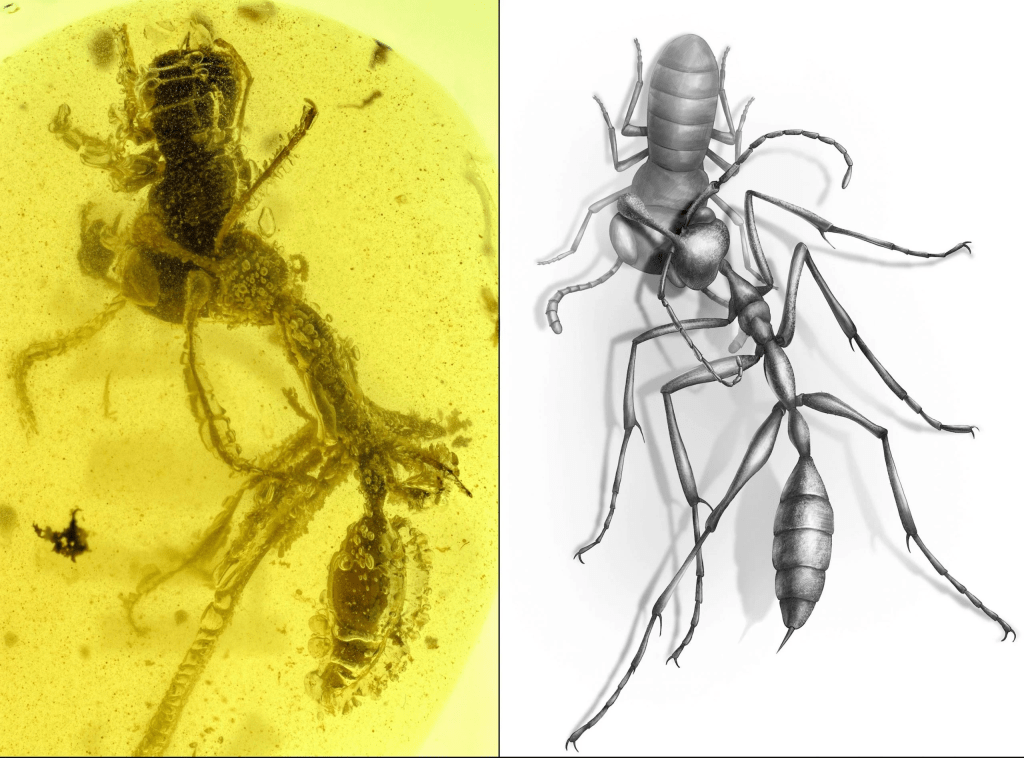
Unfortunately, we aren’t sure. There are still huge gaps in the fossil record. Animals becoming fossils is extremely rare. It’s even rarer for small animals to fossilise and ever rarer for animals without bones to fossilise. Amber makes this a bit easier but it’s still very rare. For now their extinction is a mystery. They disappeared from the fossil record before the asteroid killed the dinosaurs. More discoveries will may answer these questions.
It does seem likely that they were simply out competed by other ants that lived in larger colonies. This would have allowed them to better exploit resources, fight off competitors and fight off predators. However, other species that form smaller colonies still exist. More evidence should, hopefully, help answer these questions as we find it. Until then, why do you think they went extinct? Are you sad they’re extinct? Would you like to see a Jurassic park style zoo with extinct ant species included? Leave a comment on this post or on our Facebook group. Thanks for reading,
Alex.
If you have enjoyed this site and its content please consider becoming a Patron so I can add more content in the future. Please like and share as much as you can.
And check out what I do and where to find me here:
https://allmylinks.com/alexants
References
Barden, P. and Grimaldi, D.A., 2016. Adaptive radiation in socially advanced stem-group ants from the Cretaceous. Current Biology, 26(4), pp.515-521.
Barden, P., 2017. Fossil ants (Hymenoptera: Formicidae): ancient diversity and the rise of modern lineages. Myrmecological News, 24(1), p.30.
Barden, P., Perrichot, V. and Wang, B., 2020. Specialized predation drives aberrant morphological integration and diversity in the earliest ants. Current Biology, 30(19), pp.3818-3824.
Dlussky, G.M., 1996. ants (Hymenoptera: Formicidae) from Burmese amber. PALEONTOLOGICAL JOURNAL C/C OF PALEONTOLOGICHESKII ZHURNAL, 30, pp.449-454.
Perrichot, V., Wang, B. and Engel, M.S., 2016. Extreme morphogenesis and ecological specialization among Cretaceous basal ants. Current Biology, 26(11), pp.1468-1472.
Perrichot, V., Wang, B. and Barden, P., 2020. New remarkable hell ants (Formicidae: Haidomyrmecinae stat. nov.) from mid-Cretaceous amber of northern Myanmar. Cretaceous Research, 109, p.104381.
 Alex's Ants