
Most of the gemstones we use in jewellery come from enormous commercial mines. Others are grown in pristine laboratory conditions, untouched by soil or sunlight. There is, however, one huge gloriously tiny exception: anthill garnets.
Usually, this is the part where a click-bait site would make you scroll through a thousand words of nonsense before telling you anything interesting. But you’re here on Alex’s Ants, reading an article with “Anthill Garnets” in the title. We both know exactly why you clicked.
So let’s talk about ants digging up treasure.
Much like the dwarven kingdoms of The Lord of the Rings, ants carve deep networks of tunnels beneath the earth. Unlike dwarves, they are not mining for rubies, gold, or mithril—and I’m fairly confident they’ve never dug too greedily and too deep and unleashed a Balrog. Which probably makes the comparison pointless. But I love LOTR, so here we are.

In certain parts of Arizona, USA, especially on Navajo Nation land, harvester ants, Pogonomyrmex sp., tunnel through soil that contains small, naturally formed pyrope garnets. These garnets were created deep in the Earth’s mantle and carried upward by ancient volcanic activity, often surrounding lava tubes. Over time, the rock around them breaks down due to weathering or the movement of the Earth’s crust, leaving loose crystals mixed into the soil.

To an ant, a garnet is simply in the way. As with all the substrate they remove to dig their tunnels and chambers, they drag them upward and deposit them around the entrance of the nest. Wind and rain then wash away the lighter sand and soil, leaving behind tiny clusters of sparkling red gemstones scattered across the surface. Seeing as these nests are already quite conspicuous, these gems are not hard to find if you know where to look.
It’s nature’s strangest, cutest, least efficient mining operation.
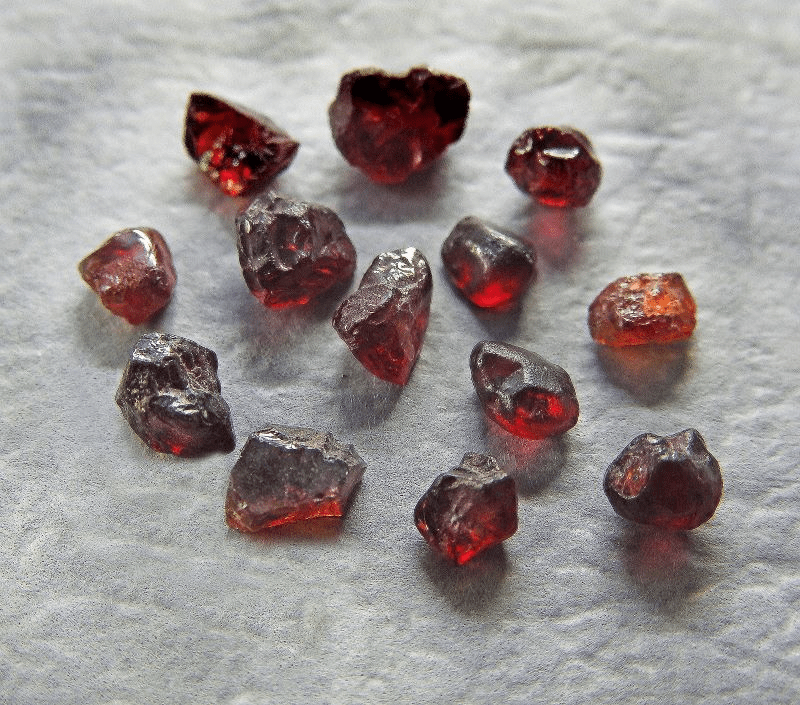
These gemstones are, in themselves, quite common. Their stories, being mined by ants, are what makes them sought after. If someone handed you jewellery and casually said, “Oh yes, these gems were dug up by ants,” you’d want to show that off immediately. And honestly? Same. I collect Fossils and Minerals and I would love to own an Anthill garnet. They are often cut and polished before being placed in jewellery.
But there’s a downside, because of course there is.
Sadly, humans are very good at ruining things. Anthill garnets often act as indicator minerals for the presence of other valuable stones deeper underground. When people spot them on the surface, some see it as an invitation to excavate the entire area—destroying ant nests in the process.
So in this case, beauty really can lead to destruction.
A note of respect.
It’s important to mention that this phenomenon occurs almost exclusively on Native American land, particularly within the Navajo Nation. The Navajo people have collected and appreciated these stones for generations, and their land and traditions deserve respect. They have even been made into clothing and ceremonial items, such as rattles.
If you ever seek out anthill garnets—whether as a collector or jewellery lover—please make sure they are ethically sourced and respectful of Navajo sovereignty. These gems aren’t just pretty; they carry cultural, geological, and ecological meaning.
I am not a Geologist nor can I claim to speak for the peoples mentioned so I highly encourage you to read more into these areas of study. Please contact me to correct any incorrect or misrepresented information. If you have any questions, comments or want to discuss further, leave a comment on this post or on our Facebook group. Thanks for reading,
Alex.
If you have enjoyed this site and its content please consider becoming a Patron so I can add more content in the future. Please like and share as much as you can.
And check out what I do and where to find me here:
https://allmylinks.com/alexants
References
- admin@rockngem (2024). Ant Hill Garnets: Tiny Miner Treasures. [online] Rockngem.com. Available at: https://www.rockngem.com/ant-hill-garnets-tiny-treasures/ [Accessed 9 Mar. 2026].
- Augusta Gem and Mineral Society (2013) What are Anthill Garnets? Available at: https://agams.club/wp-content/uploads/2013/07/121.pdf (Accessed: December 11, 2025). agams.club
- Columbia Gem House (2025) Anthill Garnet. Available at: https://columbiagemhouse.com/pages/anthill-garnet (Accessed: December 11, 2025). Columbia Gem House
- Gemworld International (2025) Gem Focus – Featuring Anthill Garnet. Available at: https://www.gemguide.com/gem-focus-april-2025-featuring-anthill-garnet-the-pyrope-unearthed-with-the-help-of-insects/ (Accessed: December 11, 2025). Gemworld International
- Geology.com (n.d.) Ant Hill Garnet? Tiny ants mine some of the best garnets!. Available at: https://geology.com/gemstones/anthill-garnet/ (Accessed: December 11, 2025). geology.com
- Hölldobler, B. and Wilson, E.O., 1990. The ants. Harvard University Press.
- MineralAuctions.com (2025) Pyrope Garnet (Anthill Garnet), Buell Park, Sawmill, Defiance Plateau, Arizona, USA. Available at: https://www.mineralauctions.com/items/pyrope-garnet-anthill-garnet-115430 (Accessed: December 11, 2025). mineralauctions.com
 Alex's Ants